Design Story
Christoph Hefti – The Missing Who?
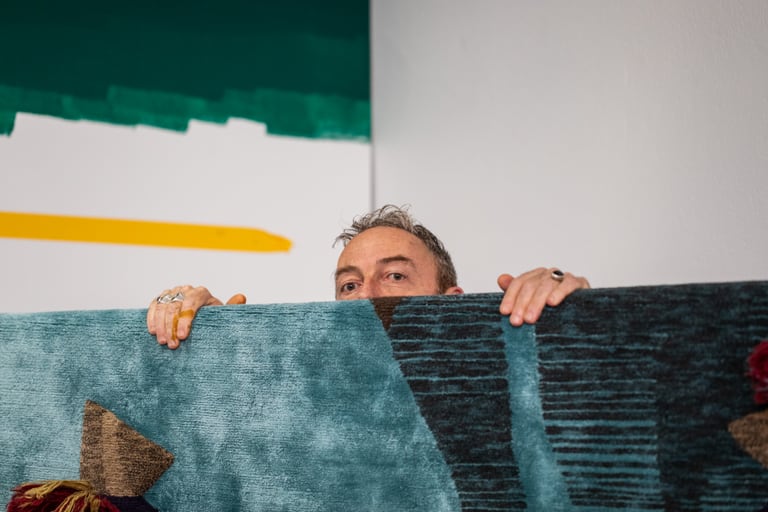
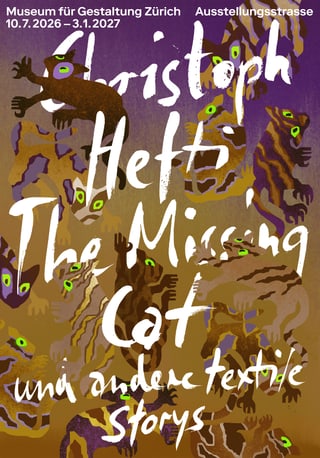
Textile design, fashion, ceramics, video: for decades, Christoph Hefti has been moving between disciplines and forms of expression. The Swiss designer and artist, who has worked for international fashion houses such as Dries Van Noten and Jean Paul Gaultier and was honoured as an ‘Honorary Companion’ of the ZHdK in 2023, has always defied simple categorisation. With the exhibition ‘The Missing Cat and Other Textile Stories’, the Museum für Gestaltung Zürich is dedicating its first comprehensive solo exhibition to him – and bringing Hefti back to the place where his career began.
Christoph Hefti, we are just days away from the exhibition opening at the Museum für Gestaltung Zürich. For you, this brings things full circle: You’re returning as an established designer and artist to the place where it all began. How does that feel?
It’s certainly a strange state of mind I’m in right now. I don’t really see it as a home game. But this building is, of course, very familiar to me as my former school – just not in this context as a museum. It’s a rollercoaster of emotions. At the same time, I’m a different person today than I was back then. I was here as a student and am now also discovering the similarities between who I was back then and who I am today. Of course, as a student I would never have imagined that I’d one day have an exhibition in this museum. It feels good to be staging this exhibition here. There aren’t that many great things about getting older, but for me this is one of them: suddenly finding yourself in situations where you wonder whether you could ever have imagined it. That my work would one day look like this and that I’d be showing it here of all places. Actually, it’s also the first time I’ve paused to look back on my work. All the pieces created over the years – not with the intention of ever being exhibited. But now that this exhibition is taking place, I realise: my works are telling me something. They’re like a mirror.
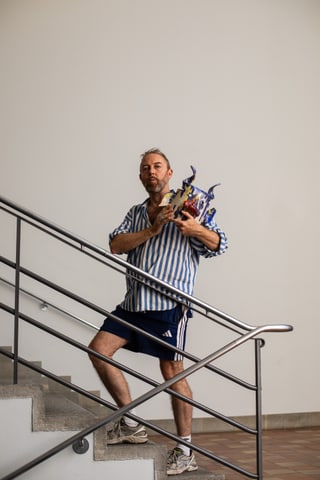
The exhibition brings together your creative output and, for the first time, presents it as a kind of ‘total work of art’ in the space. What happens when all these works are suddenly displayed side by side? Have you discovered connections or common threads that you weren’t aware of before?
Crazy things do happen, partly because I’m not the only one working on this exhibition. It’s fascinating to see how the curator, Nora Wüthrich, interprets my work from her perspective. In any case, there are connections I wouldn’t have noticed at all without taking this moment to reflect. I’m always carrying on working; I’m changing, the world is changing – and suddenly you look back and realise: there are certain things I’ve actually always been pursuing. The combination of videos and rugs, for example. For me, these works were always the furthest apart. And now that they’re appearing together in this exhibition, I realise: the tapestries and the videos do in fact share a kinship. I believe they have the same creator.
«It’s not just about the end product. It’s just as much about the journey there. You spend most of your time on the creative process. It’s actually like a partner.»
When you look back on your journey: what advice would you have liked to give your younger self? And does this also apply to students today?
Do your own thing. Know who you are in this creative world. We all assume, after all, that we have a talent. But at the start, you don’t really know exactly where that talent lies or what it actually is. You have to discover it and work out what it consists of, give it a good foundation and protect it to some extent. Ultimately, that can only be achieved through hard work. My advice is therefore: keep working, stick with it and really do your own thing. Or at least find out what your own thing is. What I’d also recommend to today’s generation – because it helped me a great deal – is to value the creative process. You spend so much time on it, and that’s why you should see it as something truly important. It’s not just about the end product. It’s just as much about the journey there. You spend most of your time on the creative process. It’s actually like a partner.
Everything is perfectly staged in the exhibition. Were there moments whilst setting up the show when you woke up in the night and thought: Will this work out? Is it good enough?
Yes, of course I have doubts. It’s great to be putting on this exhibition, but ultimately you’re still a bit on your own with your doubts. I keep having trouble making decisions, but I try to deal with them creatively. It’s definitely something that keeps me awake at night sometimes. Not necessarily the question: ‘Is this good enough?’ But rather: ‘Am I really getting my message across? Am I overdoing it? Is it too much or too little?’ With an exhibition, it’s a bit like suddenly having to declare who you are. You sit down and think: ‘The way this exhibition looks is the way I am.’ It’s a strange dialogue with yourself. Because actually, that’s not true at all; in the end, it’s just an exhibition. And yet, in a way, it is true. You have a relationship with your work, and therefore with this exhibition too.
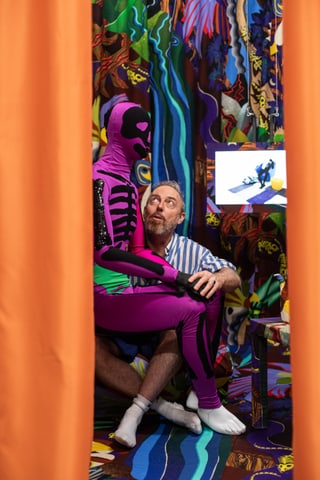
Global crises, artificial intelligence – the world is currently undergoing a radical reshuffle. Your textile worlds seem almost defiant in the face of this. Are your works an alternative vision – or more of a refuge?
I don’t know yet, but it’s probably a bit of both. Perhaps it’s also a sort of headlong rush forward. At the same time, I think it’s an exciting time. It challenges us designers and artists – in fact, all of us. It forces us to think about who we are, what we do and what we want to give to this world. You often get the feeling that a lot of things no longer make sense. But I’m a product of the 1980s. When I was at university, there was also a feeling that it was the end – no future. And when I was studying textiles, people kept saying: ‘Textiles? It’s not worth studying that anymore. It’s a dying art form; it doesn’t lead anywhere.” Seen in that light, this apocalyptic mood has actually been with me ever since my student days. That’s why I sometimes feel that I’m being defiant out of habit. And out of intuition. But I don’t create my work with the intention of being defiant. It’s simply defiant. It’s a response to our strange world. On the other hand, you could certainly say that my own working approach is very globalised. I have to give a lot of thought to what local craftsmanship means and what my relationship to it is. And also to the people who practise this craft. These are topics that were hardly ever discussed at the start of my career. Today, these questions are being debated, and I find that very interesting in turn. That’s why I find this period so exciting. It actually gives me a great deal.
For years, you designed iconic prints for fashion giants such as Dries Van Noten and Jean Paul Gaultier. What prompted you to swap the Paris fashion world for the weaving workshops of Kathmandu?
I’ve always done other things alongside fashion: art, design, music and videos. At some point, music and videos faded from my life; suddenly, there was only fashion left. That’s when I realised there had to be something else out there. It started to bore me, and I no longer really saw eye to eye with the system there either. It was less a matter of frustration than a gradual realisation. I think I’ve always been searching for something that bears my own name, something I can truly do for myself. Then, at some point, the moment came when this question became increasingly pressing. I wanted to stay in textiles. I wanted to work on a large scale – rugs are simply bigger than clothes. And I wanted to return to craftsmanship, to working with craftspeople.
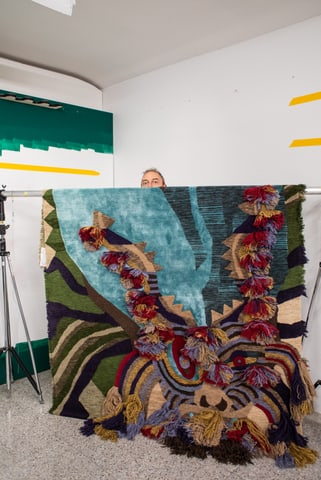
«I feel really at ease knowing that the rug is being woven by hand, that it’s in good hands – and also that the people working on it are in good hands.»
You design in Zurich or Brussels, but the rugs are woven over many months in Nepal. How do you cope with this lengthy process, where you often can’t see the result for weeks or months? Is there room for doubt?
That’s the biggest contrast to fashion, because it really does take months for a carpet like this to be made. Once I’ve finalised everything, it still takes another four or five months before I see the end result. In fashion, I would have developed two new collections in that time. At first, I found that very strange. I kept thinking I needed to change something – even though that’s no longer possible, because the rug is already being woven. But I’ve come to terms with it. And I feel really at ease knowing that the rug is being woven by hand, that it’s in good hands – and also that the people working on it are in good hands. I work with a Fairtrade organisation; that’s important to me.
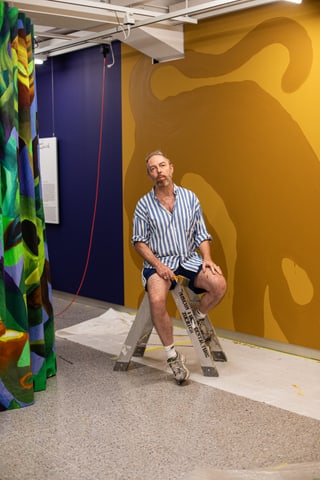
When weaving carpets, chance plays a part. How do you deal with this loss of control?
There is a loss of control, but not a very great one. And I’m happy to accept that. I give the workshop very precise instructions, which are also discussed with the weavers. When I first started making carpets, I was sometimes told that something wasn’t possible. I then looked for – and found – producers who were willing to join me on this journey. Nowadays, they’re able to produce things that, ten years ago, we first had to try out to see if they would work. That requires constant communication. And if something doesn’t work, you might find another solution. A ‘no’ is sometimes also a ‘yes’ to something else.
The latest rug, which we’ll now be seeing for the first time in the exhibition, features a cat motif. Your first solo exhibition at the Museum für Gestaltung Zürich is called ‘The Missing Cat’. What is actually missing from your textile worlds?
I’ve already touched on my doubts. I never really know when a design is finished; it’s usually the design itself that tells me when it’s ready. That’s why I actually have a real connection with this creative process. It’s the rug that tells me when it’s finished. And yet I still have doubts and ask myself: does it need anything else? Is it good enough? Or, to put it another way: is there still something "missing"? With the title of the exhibition, I also wanted to suggest that it’s actually never finished. As soon as I’ve designed and sent off a rug, I always think: ‘Now I’ll never have another idea for a rug again.’ But no sooner is it gone than I’ve already got the next idea. It’s like a constant search. For the exhibition, I had the idea of a living creature that might be there – or might not. Hence this ‘Missing Cat’. Many people know straight away what’s meant when there’s talk of a missing cat. And then there was actually my latest idea, the last rug I made for the exhibition. That’s when I realised: ‘Wow, now I’m making a rug for this very title.’ So you do actually find the missing cat at the end of the exhibition – though you’re unlikely to find your own personal one.
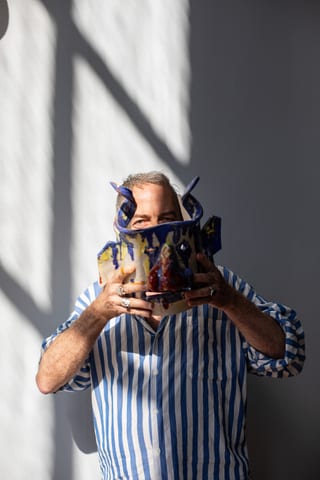
You commute between Brussels, Zurich and Kathmandu. Where is your home – and what design object can be found there?
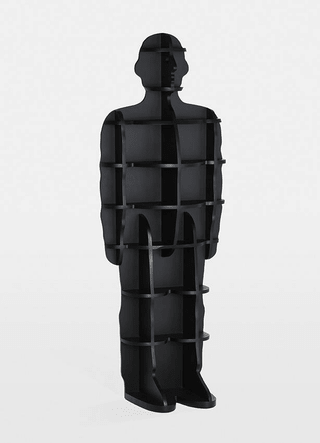
Well, my home is actually in Zurich and also in Brussels. It’s a bit of a mix, always depending a bit on the project. At my home, I have the "Fächermann" by Susi and Ueli Berger. They’re my favourite designers. That shelf is simply my absolute favourite design object. I had the chance to buy it at an auction in Munich. Since then, the "Fächermann" has been standing in my hallway, and I get pleasure from it every day. There’s this man looking at me, whom I don’t actually know at all. At the same time, my very personal belongings are on that shelf. I find this interplay inspiring.
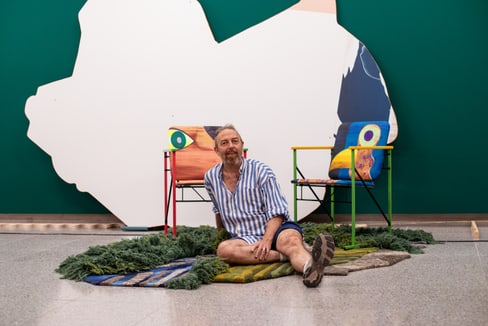
If you were a design object yourself – which one would it be?
I’d love to be the cat rug. These cats just came together particularly well when I was designing them. I sketched them with just a few strokes and immediately felt: these are spot on. Drawing them was so much fun, and I hardly had to change a thing because they were simply perfect. They’re wild, funny, a bit silly, but at the same time a bit eerie. And if I could be something like that, I’d be happy.
This article was written for Zett, the magazine of the Zurich University of the Arts.
More about the exhibition
More Design Stories
Explore new perspectives in our stories on fascinating design topics, exhibitions, and the people who shape the world of design.