Design Story
Enlightenment
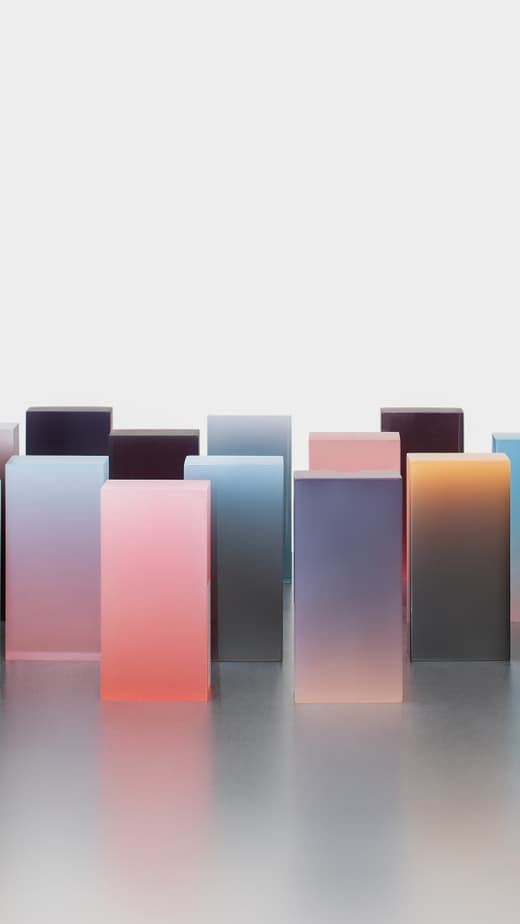
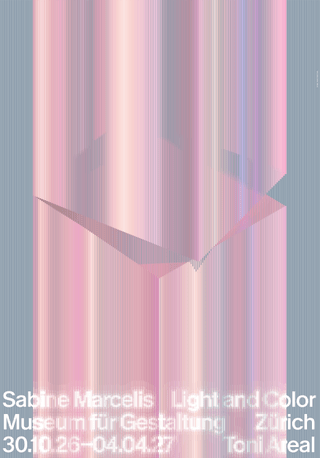
An exhibition on light and colour is risky business. With Sabine Marcelis—Light and Colour, Museum für Gestaltung Zürich is taking precisely that risk, trusting that the artist from the Netherlands knows what she’s doing.
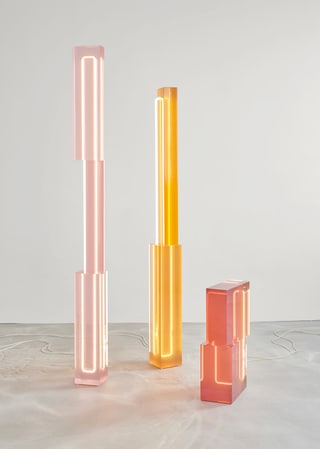
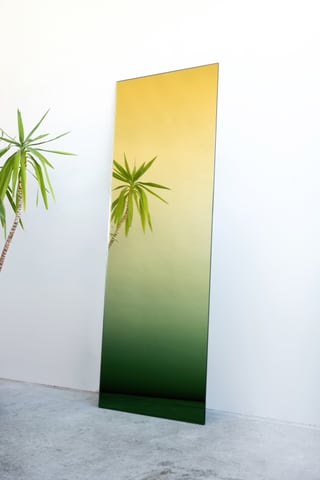
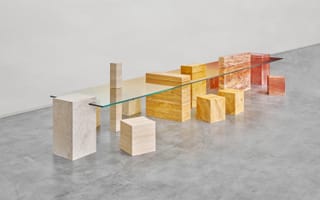
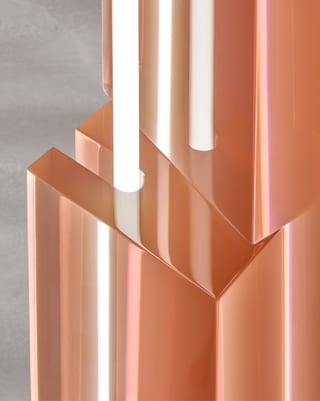
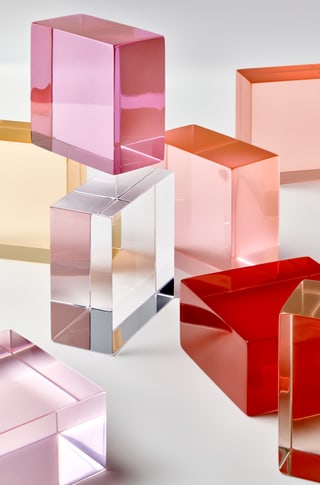
Light and colour. Behind this combination lies a whole industry of wellness installations, photogenic spaces, mellow sound design and phrases like “a journey to your inner self”. The spaces are typically pink and purple, with meaning everywhere you look. You don’t come out any wiser, just more relaxed. Spaces curated by Dutch-New Zealand designer Sabine Marcelis (b. 1985) are quite different. She has been working with resin, glass, stone and neon light for a good decade now, achieving a level of precision that means her objects appear as though made out of air, despite their sometimes monumental dimensions. Candy cubes, dawn lights, mirrors, entire rooms. Clients include galleries and fashion houses. In 2024, at the Vitra Schaudepot, she opted to arrange the collection by colour instead of chronologically. A gesture that reveals something about her mindset: for Marcelis, colour isn’t an effect, but an organizing principle.
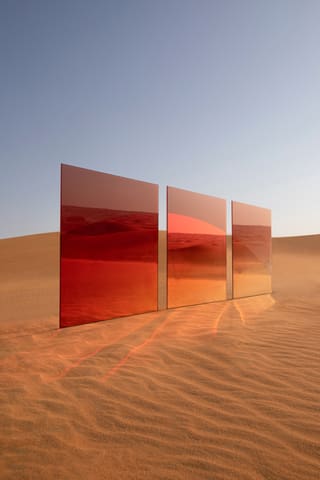
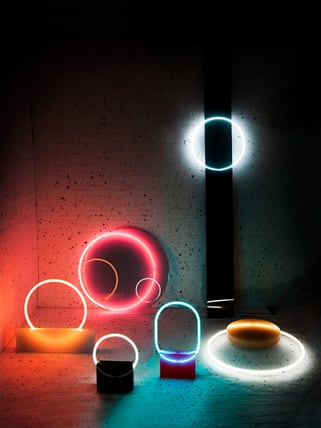
First museum exhibition
From 30 October 2026, Museum für Gestaltung Zürich is dedicating a comprehensive exhibition to her for the first time. Curator Damian Fopp is bringing together key works from the past ten years, which will be supplemented by a spatial installation, developed especially for Zurich by Marcelis, and a light tunnel that continues ad infinitum through a mirror illusion. Sounds like Instagram bait. Fopp himself takes it in his stride. It’s important to him, he says, that visitors “first enter the exhibition physically and experience the works for themselves. What happens after that is secondary. They can pull out their phones, have a lie down or even leave straight away—all reactions are valid.”
As to where her sense of colour comes from, Sabine Marcelis herself once described how it doesn’t come from her parents’ flower farm in New Zealand where she grew up, but from the mountains. The best colours, she says, emerge above the clouds when the sun bleeds into the clouds at sunset. She doesn’t have a theory of colour—she works on the basis of her intuition. The former snowboarder (a burst appendix put an end to her competitive sports career) later studied in Eindhoven. The self-professed “production nerd” has a studio in a warehouse in the port of Rotterdam. This is where she spends her days working on resin samples, glass blowing and structural calculations. Behind the sensuality lies craft. Behind the lights, calculation. And it’s precisely this which the exhibition brings to light in the form of material samples and studies. The flawless execution of the works sets them apart, says curator Fopp, whereas the material samples reveal the long development process behind them. Simplicity is the guiding principle of the exhibition. “This is a primal fear within the curatorial profession,” says Fopp on the fear of over-simplicity. “Almost all exhibitions benefit from showing fewer works and adopting clearer positioning. An overload of content weakens the message.” It’s a question of exercising self-discipline, he says.
A distinctive design and material language
What does design mean today when the gates to art have long been open, when furniture is sculpture, sculptures are spaces and spaces are experiences? Marcelis moves between the worlds of galleries, industry and commissions without making a commitment any which way. She simultaneously designs lamps for IKEA and individual pieces for collectors. According to Fopp, she has developed a distinctive design and material language whose scale operates across each of these categories all at once. Following the monographs on Jasper Morrison, Formafantasma and Tatiana Bilbao, Marcelis’ exhibition is the latest in a series through which through which Museum für Gestaltung Zürich is sharpening ist profile as a platform for contemporary trends in design. The scenography is a product of Marcelis’ own studio. Daylight is carefully directed into the exhibition room to work with the pieces instead of illuminating them. The dramaturgy is non-linear. You aren’t escorted through a narrative, but placed within situations. Emotion, says Fopp, is a tool—“because a museum is too inefficient for simply conveying knowledge.” Will it all come together? That remains to be seen. For anyone passing through Zurich in autumn, pining for the sun, craving for some light, the Toni Campus is just the ticket.
This article appeared in ZETT – the magazine of Zurich University of the Arts, Issue 19.
More about the exhibition
More Design Stories
Explore new perspectives in our stories on fascinating design topics, exhibitions, and the people who shape the world of design.